Page 11 · Start Here: The Order of Decision
The Order of Decision
A reasoning aid, not an official ASWB rule. Consent, rapport, urgent needs and legal duties can change the sequence.
SOCIAL WORK EXAM REVIEW · MASTERS & CLINICAL
When every option looks right, each drawn page connects the facts, the next step and the reason behind it.
118 illustrated pages · 10 parts · PDF by email

What Comes First + 2 bonus books
Seven real pages from the book, spanning decision-making, ethics, planning and original practice. Tap any page to read it.
Page 11 · Start Here: The Order of Decision
A reasoning aid, not an official ASWB rule. Consent, rapport, urgent needs and legal duties can change the sequence.
Page 29 · Limits, Reports and Records (Area I: Values and Ethics)
Explore whose need the choice serves, the context of a gift and the limits around conflicts of interest.
Page 39 · Equity and Justice (Area I: Values and Ethics)
Effective communication supports assessment. Consider qualified interpreters and access needs; emergencies may require immediate action.
Page 67 · How to Assess and Plan (Area II: Assessment and Planning)
For routine planning: relevant assessment, goals agreed with the client, then a method that fits. Urgent needs or legal duties may come earlier.
Page 83 · People and Methods (Area III: Intervention and Practice)
Be honest about the mandate, and find a goal they do want.
Page 108 · Practice Questions: Masters
In a small town, a client's brother, who coaches the worker's son, asks how she is doing. Best answer: D.
Page 119 · Practice Questions: Clinical
A subpoena from an ex-spouse's lawyer asks for a client's complete file. Best answer: A.
Swipe either way · Tap to enlarge · A sample of the book. Not the full PDF.
The moments when a practice question usually stalls you, and the drawn page that helps you reason through it. Pick a topic.
Two answers look right, and you can't tell which step comes first.
The book's order of decision, as a reasoning aid: consent, rapport, urgent needs and legal duties can change the sequence.
A client asks about your own life, and you're unsure how much to share.
Self-disclosure, gifts and conflicts of interest: whose need the choice serves, and where the limits are.
The client speaks another language, and the question asks what you do next.
Effective communication supports assessment: qualified interpreters, access needs, and when an emergency calls for immediate action.
In a small town, someone you know asks you how your client is doing.
An original Masters practice question set in a small town, with the reasoning behind the best answer.
A lawyer's subpoena asks for a client's complete file, and you don't know where to start.
An original Clinical practice question on a subpoena from an ex-spouse's lawyer, with why one answer fits best.
These are 5 of the 118 illustrated pages: every topic has its own.
When reasoning through a question, consider whether the facts indicate an immediate safety concern, whether sufficient information has been gathered from the client’s perspective, and whether planning or intervention is appropriate at this point. A reasonable action can still come too early. This is a study aid rather than a universal sequence: the wording and facts of the question determine what fits, including consent, engagement and legal duties.
You can recognize the concepts, but want a clearer way to explain why one reasonable option comes before another.
Open one topic on a break or after dinner, then return to your course or question bank with the reasoning in view.
Shared pages and level-specific sections lead into separate practice sets. Your provincial regulatory college decides whether you need the exam, and at which level.
Ten parts, with the actual topics and page ranges from the book.
Follows the August 2026 ASWB content outlines; Masters-only and Clinical-only topics are marked. An independent review companion, not official ASWB material or a complete prep course.
Here's how exam day feels when you've studied with the guide.
Less doubt, more calm, question after question.
A guide and its companion books, together in one digital pack.
THE CORE GUIDE
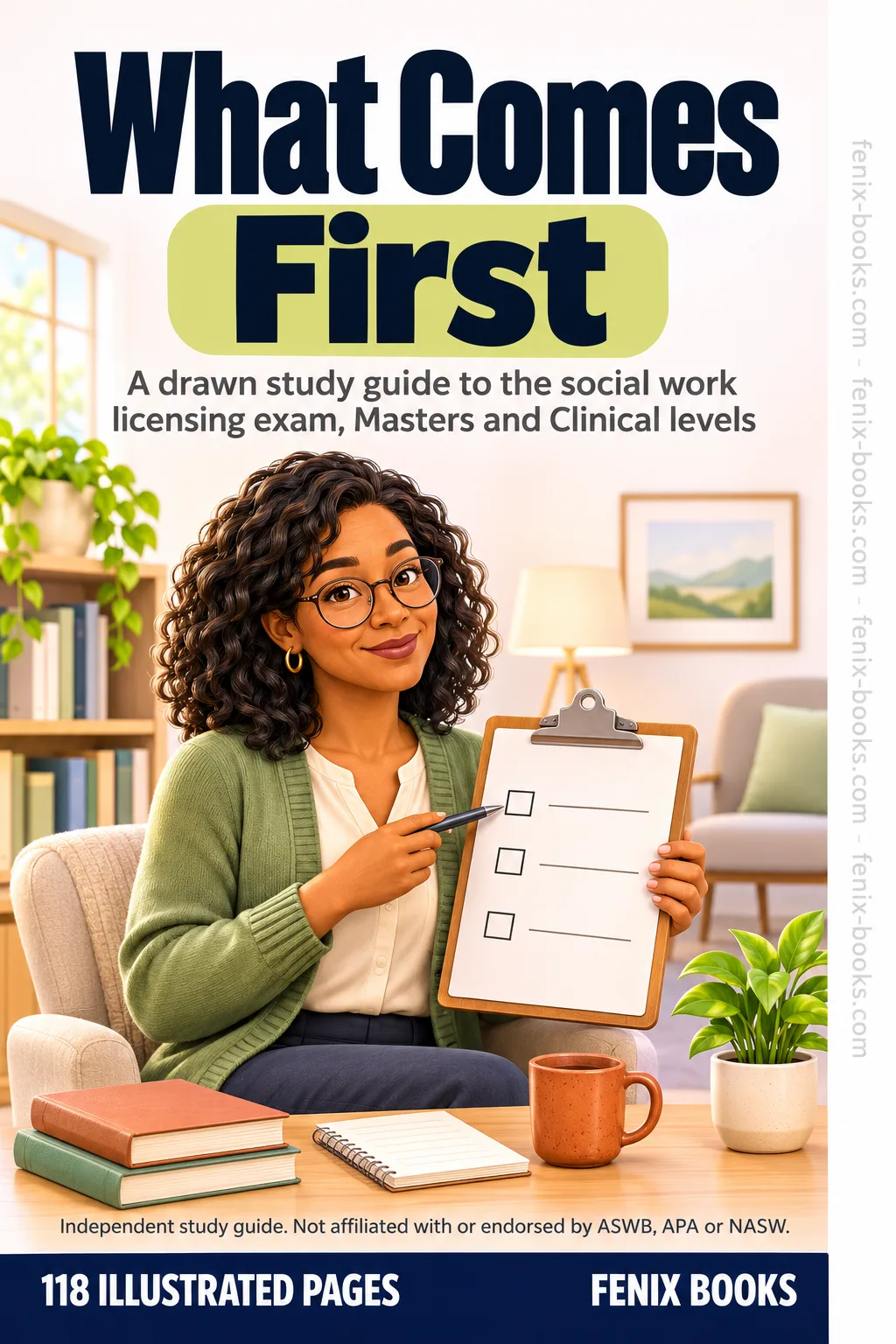
Build your reasoning across ethics, assessment, planning and practice. Includes 118 illustrated topic pages in a 124-page PDF, with 11 original Masters questions and 11 original Clinical questions.
FREE BONUS 01
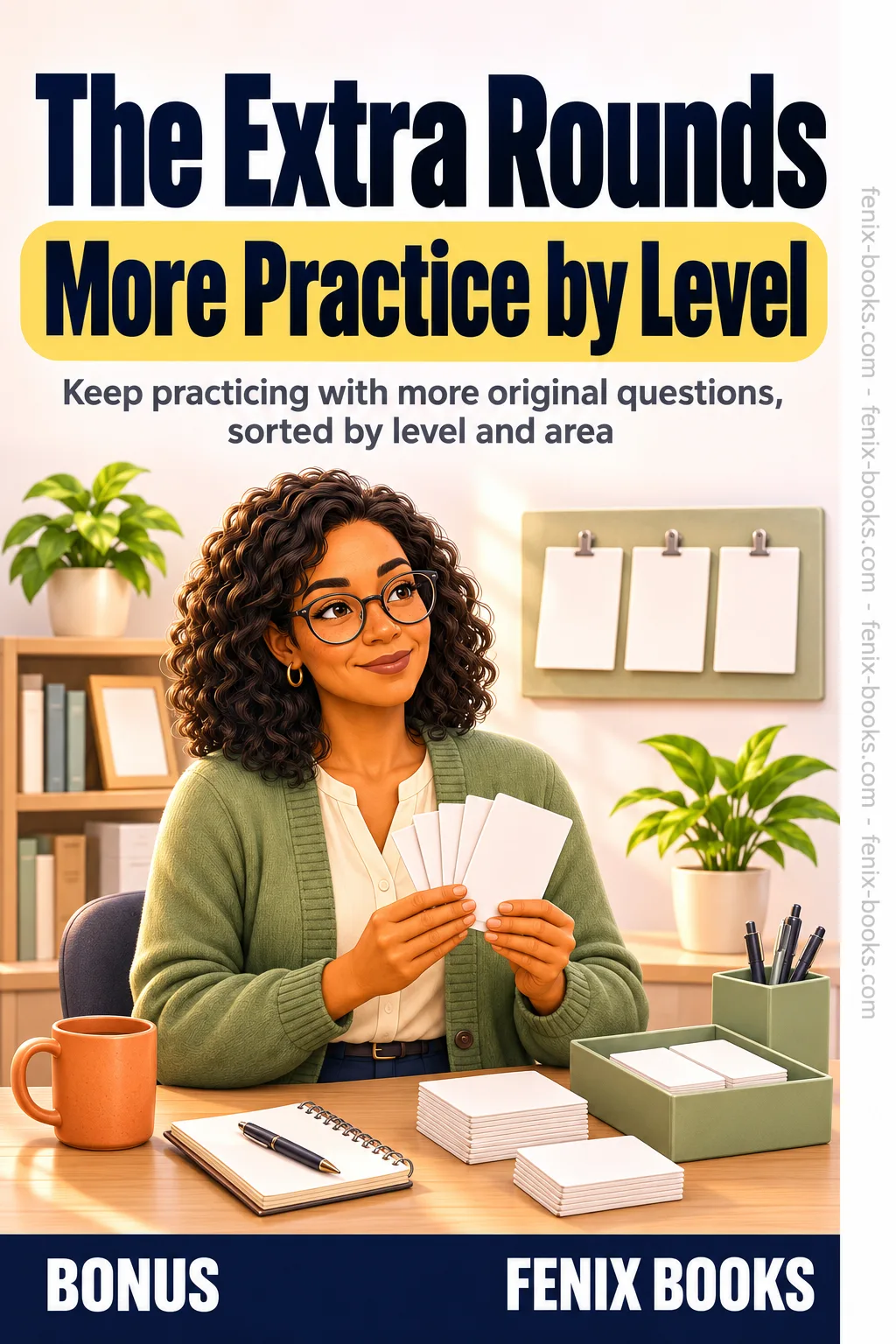
Keep practising with additional original questions, organized by level and area, with the reasoning behind every option.
FREE BONUS 02
Revisit the order of decision on printable, one-page drawn sheets organized by the kind of situation.
One payment · No subscription
The drawn review guide and both companion books, together.
YOUR COMPLETE PACK
What Comes First + 2 bonus books
One payment · No subscription
You save CA$ 57
What Comes FirstIncluded
The Extra Rounds: More Practice by LevelFREE
First or Next: Decision SheetsFREE
Protected checkout · PDF delivery by email
If you're seeing this opportunity, take it.
Offers change, and we can't guarantee the same price tomorrow.
Digital books. No physical books are shipped.
Five selected experiences with this guide.
When all four multiple-choice options seem clinically valid, this guide trains you to spot what you must do FIRST.
It completely rewired my test-taking strategy for both Masters and Clinical levels.
One drawn page per concept cuts right through the exam trickery.
You have a 30-day, 100% money-back guarantee. Try the guide in your study sessions. If it does not help you compare answer choices, email us with what did not work and request a full refund.
hello@fenix-books.comBoth. Shared topics are combined, level-specific material is marked, and each level has its own set of 11 original practice questions with explanations. Confirm which exam level your provincial regulatory college requires for registration.
It is built on the current ASWB Masters and Clinical content outlines (August 2026), the same exam used in the U.S. and Canada. Its legal and ethics examples follow the U.S. framework (for example HIPAA and the NASW Code of Ethics); it does not cover provincial privacy or child-protection law or the CASW Code of Ethics. It does not cover the Bachelors exam. Not every province requires the ASWB exam: check with your provincial regulatory college whether you need it and at which level.
The main PDF has 124 pages, including 118 illustrated topic pages. Its final two parts contain 11 Masters questions and 11 Clinical questions. The Extra Rounds adds practice organized by level and area, with explanations for the answer choices.
No. Use it as a drawn review companion. It helps you revisit concepts and the reasoning behind choices alongside your other preparation; it is not a complete exam-prep course.
No. Independent study guide. Not affiliated with or endorsed by ASWB, APA, NASW or CASW. Every practice question is original—not an official, recalled or reproduced exam question.
No. It is this book’s study aid, not an official ASWB rule or a fixed answer formula. Read the whole question: the facts and wording determine what fits, including consent, engagement and legal duties.
No. Registration requirements vary by province, so check with your provincial regulatory college. The guide does not guarantee an exam result or replace education, supervision, clinical judgment or professional consultation.
What Comes First, The Extra Rounds: More Practice by Level and First or Next: Decision Sheets, delivered as PDFs by email. Read on your device or print for your own use. No physical books are shipped.
No. The displayed price is a single payment for the digital pack.
Try the guide in your study sessions. If it does not help you compare answer choices, email hello@fenix-books.com within 30 days with what did not work and request a 100% refund.
YOUR NEXT STEP
Explore one drawn topic at a time, then return to your practice with the reasoning in view.
I want the illustrated guide · CA$ 37.90PDF by email · 30-day money-back guarantee